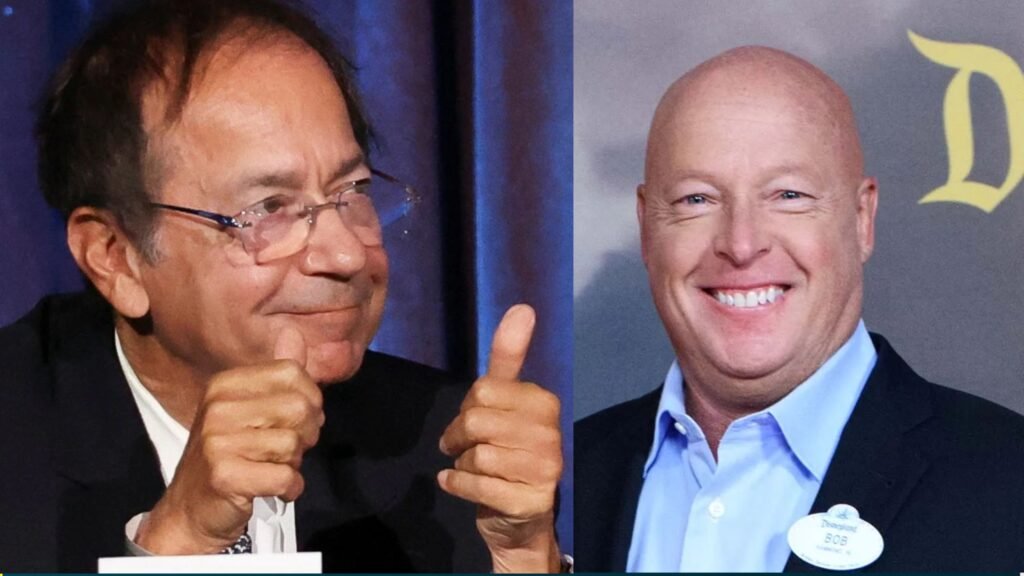
The American business world includes executives who manage global corporations and investors who influence financial markets through strategic decisions. Bob Chapek and John Paulson represent two distinct paths to professional prominence. Chapek became widely known for leading The Walt Disney Company, while Paulson established his reputation in finance as the founder of the investment firm Paulson & Co.
Although the names Bob Chapek and John Paulson may appear together in online searches, their professional backgrounds are fundamentally different. Understanding their careers provides useful insight into corporate leadership, investment strategy, financial risk, and the different ways individuals can influence the American business landscape.
It is also important to distinguish a shared search term from a verified relationship. Their names appearing together does not establish a personal connection, business partnership, or joint investment.
Who Is Bob Chapek?
Bob Chapek is an American business executive best known for serving as chief executive officer of The Walt Disney Company from February 2020 until November 2022. Before becoming CEO, he spent nearly three decades working across several of Disney’s major business divisions.
His career included responsibilities in home entertainment, film distribution, consumer products, and theme parks. This broad operational experience helped establish his reputation as an executive familiar with the commercial and logistical demands of a global entertainment company.
Early Career and Professional Background
Chapek’s professional journey began outside Disney. He worked in brand management at H. J. Heinz Company and in advertising at J. Walter Thompson before joining Disney in 1993.
His educational background combined scientific training with business administration. He earned a bachelor’s degree in microbiology from Indiana University Bloomington and an MBA from Michigan State University.
These experiences provided a foundation for a career that blended marketing, product distribution, brand management, and large-scale operations.
His Rise Through Disney
Chapek advanced through several leadership positions at Disney, gaining experience in areas that generated revenue from the company’s entertainment brands and intellectual property.
His responsibilities included home entertainment, film distribution, consumer products, licensing, merchandise, and theme park operations.
In 2015, he became chairman of Walt Disney Parks and Resorts. He subsequently led the broader Parks, Experiences and Products division before being appointed CEO.
This progression illustrates a common corporate leadership model: executives gain experience across multiple departments before assuming responsibility for an entire organization.
His Tenure as Disney CEO
Chapek became CEO during an unusually difficult period for the entertainment industry. The COVID-19 pandemic disrupted theme park operations, theatrical releases, travel, and other parts of Disney’s business.
His tenure involved navigating these operational challenges while the company continued adapting to streaming, changing consumer behavior, and the economics of producing entertainment for multiple platforms.
Chapek also faced disagreements and organizational challenges that attracted attention from employees, investors, and the media. In November 2022, Disney announced that Bob Iger would return as CEO, replacing Chapek.
His experience demonstrates how leading a major entertainment company requires more than operational efficiency. Executives must balance creative priorities, employee relationships, customer expectations, shareholder interests, and long-term investment decisions.
Who Is John Paulson?
John Paulson is a prominent American investor known for founding Paulson & Co. in 1994 and for making major investment gains by betting against the U.S. subprime mortgage market before the 2008 financial crisis.
Unlike Chapek, whose career centered on managing an entertainment corporation, Paulson built his reputation by identifying financial opportunities, evaluating market risks, and managing investment capital.
His career illustrates how research and a willingness to challenge prevailing market assumptions can influence investment outcomes.
Education and Entry Into Finance
Paulson earned a finance degree from New York University in 1978 and an MBA from Harvard Business School in 1980. He subsequently worked at Boston Consulting Group and several investment firms, including Bear Stearns.
These roles exposed him to corporate finance, mergers and acquisitions, and investment strategies involving complex business transactions.
In 1994, he established Paulson & Co., creating a platform for pursuing investment opportunities across financial markets.
The Investment That Made Him Famous
Paulson became especially well known for his position against the U.S. housing market before the financial crisis.
During the years leading up to 2008, the expansion of mortgage lending and the packaging of mortgage loans into securities created significant risks across the financial system. Paulson and his investment team anticipated problems in the subprime mortgage market and established positions that benefited when mortgage-related assets deteriorated.
The strategy generated extraordinary returns for his funds and made him one of the most widely discussed investors of the financial crisis era.
However, the episode should not be interpreted as proof that predicting a market downturn is easy. Identifying a potential weakness, choosing the right financial instruments, managing timing, and surviving adverse market movements are separate challenges.
Paulson’s career also illustrates the limits of relying on a single successful investment. Financial markets change, and strategies that work under one set of economic conditions may perform differently in another.
Philanthropy and Educational Contributions
Paulson’s public profile extends beyond investing. He and his family have supported educational institutions, health organizations, and cultural initiatives.
In 2015, Paulson pledged $400 million to Harvard University for its School of Engineering and Applied Sciences. The gift became a major milestone in the university’s fundraising history, and the school was subsequently named the Harvard John A. Paulson School of Engineering and Applied Sciences.
His philanthropic activities demonstrate how financial success can translate into long-term support for education, research, and public institutions.
Bob Chapek and John Paulson: Is There a Direct Connection?
One of the main questions behind this search term is whether the two men have worked together, invested in the same company, or maintained a documented professional relationship.
There is no widely established public evidence of a significant direct business partnership between Bob Chapek and John Paulson. Their individual biographies point to different professional paths: Chapek’s career was built around Disney and entertainment management, while Paulson became known for hedge fund investing and financial markets.
This distinction matters because search engines can display two names together for many reasons. A combined keyword does not establish that the individuals have met, worked together, shared investments, or maintained a personal relationship.
To confirm a specific connection, researchers would need stronger evidence, such as a corporate filing, a joint announcement, a documented transaction, or credible reporting describing their involvement in the same business activity.
Why Might People Search for Both Names?
Several factors can explain interest in two prominent business figures appearing together in a search.
Interest in influential business leaders: Both men have attracted attention for operating at high levels of the American business world. Chapek led a major entertainment company, while Paulson became a recognized figure in investment management.
Curiosity about corporate ownership and investment: People researching Disney, its shareholders, or the relationship between corporate management and financial markets may encounter the names of executives and investors in related business coverage. However, general interest in the same industry does not establish a direct connection between specific individuals.
Online biography and relationship searches: Searchers frequently combine public figures’ names to investigate possible relationships, professional histories, or shared business interests. The results can include relevant biographies as well as claims that require independent verification.
The most reliable approach is to distinguish documented facts from assumptions rather than treating repeated online references as confirmation.
Bob Chapek vs. John Paulson: Key Differences
Although both men are associated with business leadership, their roles, expertise, and professional achievements differ considerably.
| Category | Bob Chapek | John Paulson |
|---|---|---|
| Primary field | Entertainment and corporate management | Finance and investment management |
| Best-known organization | The Walt Disney Company | Paulson & Co. |
| Career foundation | Marketing, distribution, and business operations | Investment analysis and financial markets |
| Major public milestone | Becoming Disney CEO in 2020 | High-profile investment gains during the subprime mortgage crisis |
| Main professional focus | Managing a complex global business | Evaluating investments and managing financial risk |
| Public legacy | Corporate leadership and entertainment operations | Investment strategy and philanthropy |
The comparison shows that professional influence can take several forms. One executive may shape how a global company operates, while an investor may influence capital allocation through investment decisions.
Neither career path is inherently superior. Each requires different skills, measures of success, and approaches to uncertainty.
What Their Careers Teach About Business Leadership
The careers of Chapek and Paulson offer several lessons for people studying management, entrepreneurship, and finance.
Operational Experience Matters
Chapek’s progression through Disney’s divisions illustrates the value of understanding how different parts of a business work together. Marketing, distribution, merchandise, customer experience, and operations can all affect an organization’s performance.
For aspiring executives, developing expertise in one area is useful, but understanding how decisions affect the entire organization becomes increasingly important as responsibilities grow.
Independent Analysis Can Reveal Opportunities
Paulson’s investment history highlights the importance of examining assumptions rather than automatically following prevailing market sentiment.
In investing, this means studying underlying assets, potential losses, market conditions, and the possibility that an apparently attractive opportunity has already been priced into the market.
Independent thinking, however, must be paired with sound risk management. Even a well-researched investment thesis can fail because of poor timing, unexpected developments, or inaccurate assumptions.
Reputation Depends on More Than One Achievement
High-profile careers are often summarized through a defining moment: an executive appointment, a major transaction, or an unusually successful investment.
In reality, long-term professional reputations are shaped by a broader record of decisions and outcomes. Executives must respond to changing markets, employee expectations, competition, and operational setbacks. Investors must continually reassess opportunities as economic conditions change.
For readers evaluating business leaders, it is useful to consider the complete career rather than judging someone solely by a single success or controversy.
Financial Success and Corporate Success Are Different Measures
A corporate executive’s performance may be evaluated through operating results, strategic execution, customer satisfaction, and organizational resilience. An investor’s performance may be assessed through returns, risk-adjusted results, capital preservation, and consistency over time.
These measures can overlap, but they are not interchangeable. A company can be commercially successful without producing exceptional investment returns over every period, and a profitable investment does not necessarily indicate strong corporate management.
Understanding this difference makes comparisons between business executives and investors more meaningful.
Frequently Asked Questions
Are Bob Chapek and John Paulson business partners?
There is no widely documented evidence establishing a significant direct business partnership between them. Their publicly known careers are centered on different fields: entertainment management and investment finance.
What is Bob Chapek best known for?
Chapek is best known for serving as CEO of The Walt Disney Company from February 2020 to November 2022. Before becoming CEO, he held several senior positions across Disney’s consumer products, distribution, and parks businesses.
What is John Paulson best known for?
Paulson is best known for founding Paulson & Co. and earning major investment gains from positions against the U.S. subprime mortgage market before the 2008 financial crisis.
Did Bob Chapek work for Paulson & Co.?
Chapek’s publicly documented career is primarily associated with Disney and earlier positions in marketing and advertising. There is no widely established public evidence that he worked for Paulson & Co.
Did John Paulson invest in Disney?
A specific investment relationship should not be assumed without reliable evidence identifying the relevant transaction, investment vehicle, and period. The fact that Paulson is an investor and Chapek led Disney does not independently establish that Paulson invested in the company.
What industries are associated with these two figures?
Chapek is associated primarily with entertainment, theme parks, film distribution, and consumer products. Paulson is associated with hedge funds, investment management, financial markets, and philanthropy.
Why is John Paulson associated with the 2008 financial crisis?
Paulson gained widespread recognition for investment positions that benefited from the deterioration of the U.S. subprime mortgage market. His success became one of the best-known investment stories connected to the housing-market collapse.
What can entrepreneurs learn from their careers?
Entrepreneurs can learn the value of operational knowledge, disciplined decision-making, independent analysis, and adapting to changing conditions. Chapek’s career highlights corporate operations, while Paulson’s illustrates investment research and financial risk assessment.
Are the two men involved in the same industry?
Their professional fields are different, although entertainment companies and financial markets can intersect through public stock ownership, corporate finance, and capital allocation. Such industry-wide connections do not prove a direct relationship between two individuals.
How can readers verify claims about their professional relationship?
Readers should look for primary documents, official corporate announcements, regulatory filings, and credible reporting. Claims about shared investments or partnerships should identify a specific event or transaction rather than relying on a shared search result.
Conclusion
Bob Chapek and John Paulson represent two different routes to prominence in American business. Chapek built his career through corporate management and became CEO of one of the world’s most recognizable entertainment companies. Paulson established himself as an investor through financial analysis, high-profile market positions, and a substantial philanthropic record.
Their careers provide useful perspectives on leadership, risk, strategic thinking, and professional achievement. However, their names appearing together in search results should not be mistaken for evidence of a direct business or personal relationship.
For anyone researching Bob Chapek and John Paulson, the most useful starting point is to understand their individual backgrounds, compare their professional contributions, and rely on verifiable evidence before drawing conclusions about any connection between them.