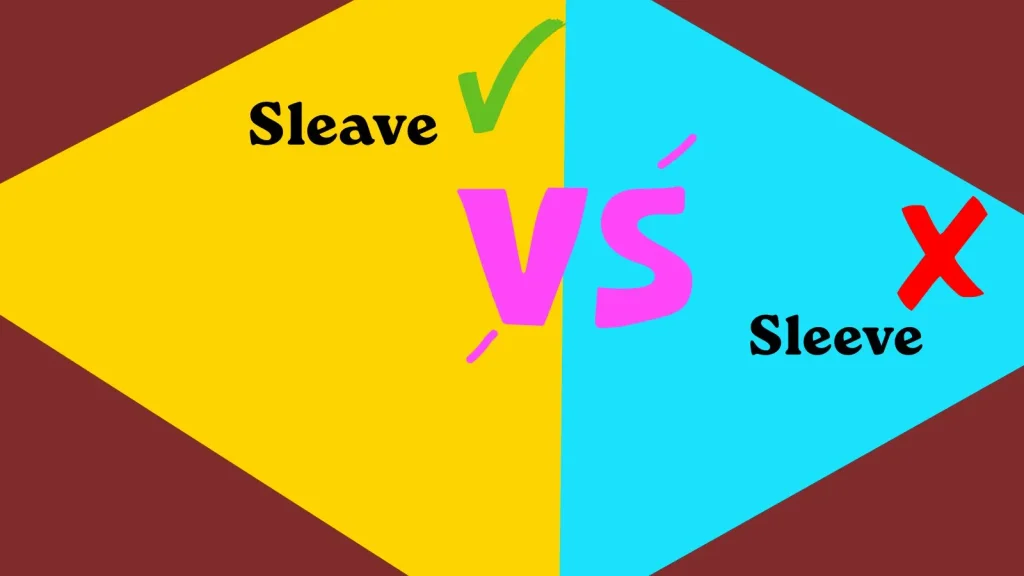
When two words look almost identical, it is easy to confuse them. Sleave vs sleeve is a good example because the letters are arranged so similarly that a quick typo can go unnoticed. For most everyday writing, however, the distinction is straightforward: “sleeve” is the standard spelling when referring to the part of a shirt, jacket, or other garment that covers the arm.
“Sleave” is not simply an alternative spelling of “sleeve.” It is a much less common English word with a specialized historical meaning. Understanding that distinction can help writers avoid spelling errors and recognize unusual uses when they encounter them in older or specialized texts.
Sleave vs Sleeve: The Basic Difference
The easiest way to understand the difference is to look at how each word is normally used.
Sleeve is the familiar word used for a part of clothing that covers all or part of the arm. It can also describe a protective or covering tube around an object.
Sleave, by contrast, is an uncommon word associated historically with silk thread or loosely prepared silk, particularly silk that has not yet been spun or woven into finished material.
For modern American English, the practical rule is simple:
If you are talking about the arm covering on a shirt, sweater, coat, or jacket, use “sleeve.”
Examples of “sleeve”
A few everyday examples make the distinction clear:
“Her jacket has long sleeves.”
“Roll up your sleeves before washing the car.”
“The shirt has a short sleeve on each side.”
“The technician placed a protective sleeve around the cable.”
In each of these sentences, sleeve is the appropriate word.
Example of “sleave”
“Sleave” appears primarily in historical, literary, or specialized contexts. It can refer to a mass or strand of silk prepared for spinning.
Because this meaning is uncommon in everyday American English, many readers may never encounter “sleave” outside older dictionaries, historical texts, or discussions of textiles.
What Does “Sleeve” Mean?
The noun sleeve has several related uses, but its most familiar meaning is the part of a garment that extends from the shoulder or upper body along the arm.
Sleeves can vary considerably in design. Clothing may have short sleeves, long sleeves, three-quarter sleeves, cap sleeves, bell sleeves, raglan sleeves, or sleeveless construction.
The word can also be used beyond clothing.
For example, a protective sleeve can cover a cable, document, tool, container, or other object. A record or album may come in a paper sleeve, while a card or document can be placed inside a protective sleeve.
The common idea is that a sleeve functions as a covering or enclosing layer.
Why Do People Write “Sleave” Instead of “Sleeve”?
The spelling mistake is understandable because Sleave vs Sleeve differ by only one letter.
The key difference is the vowel:
- Sleeve → s-l-e-e-v-e
- Sleave → s-l-e-a-v-e
The pronunciation of sleeve also makes the spelling easy to remember once you associate it with the common word. It is pronounced approximately like “sleev.”
Because “sleave” is itself a real but uncommon English word, spell-checking may not always provide the kind of correction a writer expects. A person who types “sleave” may therefore be using a legitimate dictionary word in the wrong context rather than creating an obviously invalid spelling.
Is “Sleave” a Correct Word?
Yes, sleave is a real English word, but that does not make it interchangeable with “sleeve.”
Historically, “sleave” has been used in connection with silk thread or silk prepared in a loose, untwisted form. The word is now rare and is unlikely to appear in ordinary conversations about clothing.
This is an important distinction in English: a word can be technically correct while still being inappropriate for a particular meaning.
For example, if someone writes:
“The dress has a beautiful sleave.”
The intended word is almost certainly sleeve.
On the other hand, encountering “sleave” in an old textile-related document does not necessarily mean the writer made a spelling mistake. The historical word may be intentional.
Is “Sleeve” Always the Correct Choice?
For modern clothing-related writing, sleeve is the correct choice.
Consider these common phrases:
Long sleeve shirt
Short sleeve shirt
Sleeve length
Sleeve opening
Sleeve design
Sleeve cuff
Sleeve pattern
Rolled-up sleeves
These expressions all use sleeve.
The same spelling applies when the word is used metaphorically or for a physical covering around something else.
Sleave vs Sleeve in Clothing
The confusion becomes especially important when discussing clothing.
A sleeve is an integral part of many garments. Its length, shape, width, and construction can affect both appearance and comfort.
Long sleeves
Long sleeves generally extend toward the wrist and are common in sweaters, dress shirts, jackets, coats, and other garments designed to provide greater arm coverage.
Short sleeves
Short sleeves end above the elbow or around the upper arm, depending on the garment’s design.
Sleeveless garments
A garment without sleeves is described as sleeveless, not “sleave-less.”
For example:
“She wore a sleeveless dress to the summer event.”
Sleeve length
When shopping for clothing, sleeve length can be an important measurement. It may be listed in product descriptions or sizing information, particularly for dress shirts, jackets, and other fitted garments.
Common Phrases Using “Sleeve”
Learning common expressions is one of the easiest ways to remember the correct spelling.
“Roll up your sleeves”
This expression literally means to push the sleeves of a garment upward. It can also be used figuratively to describe getting ready to do difficult or practical work.
Example:
“We have a lot to accomplish, so it is time to roll up our sleeves.”
“Up your sleeve”
The phrase “have something up your sleeve” means to have a secret idea, plan, trick, or resource that can be used when needed.
Example:
“She always seems to have another solution up her sleeve.”
This expression is another strong reminder that the standard spelling is sleeve.
“Short sleeve” and “long sleeve”
These are common clothing descriptions in American English.
For example:
“I need a long-sleeve shirt for the cooler weather.”
“Short-sleeve shirts are comfortable during hot weather.”
How to Remember the Spelling of “Sleeve”
A simple memory trick is to connect sleeve with other words that contain the same long “ee” sound and spelling pattern.
Think:
sleeve → sleeve length → long sleeve → short sleeve
The double e in “sleeve” is the part to remember.
You can also associate the word with the related verb sleeve, as in placing something inside a protective covering, although the clothing noun is by far the more common use.
Sleave vs Sleeve: Common Mistakes
Several mistakes appear repeatedly when people write about clothing.
Mistake 1: Using “sleave” for clothing
Incorrect:
“The jacket has detachable sleaves.”
Correct:
“The jacket has detachable sleeves.”
Mistake 2: Searching for “sleave length”
If you are looking for clothing measurements, the correct phrase is sleeve length.
Mistake 3: Writing “short sleave”
The correct phrase is short sleeve.
Mistake 4: Assuming “sleave” is simply an alternate spelling
Although “sleave” exists as a rare historical word, it is not the standard spelling of the clothing term.
Is “Sleave” Used in Modern English?
It can be found, but it is uncommon.
Modern English contains many words that survive mainly in historical, literary, technical, or specialized contexts. “Sleave” belongs to this category for most contemporary readers.
Someone researching the history of textiles, silk production, or older English literature may encounter it. In everyday American writing, however, it is far more likely to be a spelling mistake when the intended meaning is a garment covering.
This difference between dictionary validity and ordinary usage is useful when evaluating unfamiliar words.
How Dictionaries Can Cause Confusion
A dictionary may list “sleave” as a legitimate word, which can create confusion for someone trying to determine whether they have made a typo.
The important question is not simply:
“Is this word real?”
Instead, ask:
“Does this word have the meaning I need in this sentence?”
If the sentence is about a shirt, jacket, coat, or another garment, sleeve is the appropriate word.
If the context concerns historical silk terminology, “sleave” may be relevant.
Context therefore determines whether the unusual spelling is intentional or erroneous.
Sleave vs Sleeve: Quick Comparison
| Word | Typical meaning | Modern everyday use |
|---|---|---|
| Sleeve | Part of a garment covering the arm; also a protective covering | Very common |
| Sleave | Historical/specialized term associated with silk thread or material | Rare |
This distinction makes the choice relatively simple for modern writers.
Frequently Asked Questions About Sleave vs Sleeve
Is “sleave” the correct spelling for clothing?
No. When referring to the part of a shirt, jacket, sweater, or coat that covers the arm, the correct spelling is sleeve.
Is “sleave” a real English word?
Yes. “Sleave” is a rare historical English word associated with silk thread or loosely prepared silk. It is not normally used as an alternative spelling of “sleeve.”
What is the correct spelling: sleave or sleeve?
For clothing, sleeve is correct. The word has two consecutive “e” letters before the “v.”
How do you spell sleeve?
The standard spelling is s-l-e-e-v-e: sleeve.
What is a sleeve?
A sleeve is the part of a garment that covers the arm. The term can also refer to a protective or enclosing covering placed around another object.
Why do people confuse sleave and sleeve?
They look and sound similar, and the uncommon word “sleave” is a genuine English word. That combination can make the spelling mistake harder to notice.
Is “sleave” an old word?
Yes. Its use is primarily historical or specialized, particularly in connection with silk and textile terminology.
Should I write “long sleave” or “long sleeve”?
The correct phrase is long sleeve. For example, “a long-sleeve shirt” is standard modern usage.
Is “sleeve” only used for clothing?
No. A sleeve can also refer to a protective or enclosing covering around an object, such as a cable sleeve or document sleeve.
What is the easiest way to remember “sleeve”?
Remember the double e: sleeve. If you are describing the part of clothing that covers an arm, use “sleeve.”
Final Takeaway
The difference between sleave vs sleeve is mainly a matter of context. Sleeve is the standard modern English word for the part of a garment that covers the arm, as well as for certain protective coverings. Sleave is a rare historical term associated with silk and should not normally be used as a substitute for “sleeve.”
So when writing about shirts, jackets, coats, sweaters, or clothing measurements, remember the simple rule: double “e” means sleeve.





1 thought on “Sleave vs Sleeve What’s the Difference and Which Spelling Is Correct?”
Comments are closed.