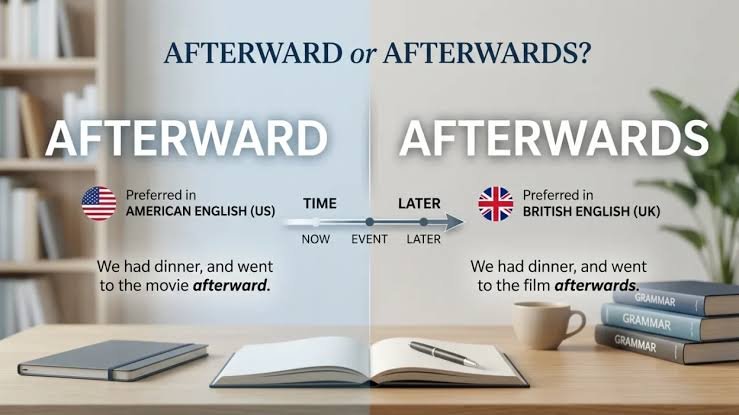
If you have ever paused while writing a sentence because you could not decide between afterward vs afterwards, you are not alone. Both words are standard English adverbs, both refer to something happening later, and in many sentences they can be used interchangeably.
The main difference is not meaning but regional preference and style. In American English, afterward is generally the more common form. Afterward vs Afterwards is especially common in British English and other varieties of English.
That does not mean “afterwards” is incorrect in American English. It is a legitimate word and will be understood without difficulty. However, writers following American English conventions will often choose “afterward.”
Understanding this small distinction can help you write more naturally and consistently.
What Does “Afterward” Mean?
Afterward means at a later time or after something has happened. It is an adverb that describes an action or event occurring after a particular point in time.
For example:
We went out for dinner afterward.
Here, “afterward” means after the event or activity that was previously mentioned.
More examples include:
- She finished the meeting and called her manager afterward.
- We visited the museum and had coffee afterward.
- He apologized afterward.
- The students discussed the lesson afterward.
- They realized their mistake afterward.
The word does not necessarily identify exactly when the later event happened. It simply establishes that it happened after something else.
What Does “Afterwards” Mean?
Afterwards has essentially the same meaning as “afterward.” It refers to a later time, usually following an event that has already been mentioned.
For example:
We went out for dinner afterwards.
The meaning is virtually identical to:
We went out for dinner afterward.
Other examples include:
- She called me afterwards.
- They talked about the decision afterwards.
- We went home afterwards.
- He felt better afterwards.
- The team celebrated afterwards.
So, when comparing afterward vs afterwards, there is generally no meaningful difference in definition.
Afterward vs Afterwards: The Main Difference
The biggest distinction is regional usage.
American English tends to favor afterward, while British English commonly uses afterwards. Both forms exist in dictionaries and are grammatically acceptable.
Consider these examples:
American English:
We discussed the issue afterward.
British English:
We discussed the issue afterwards.
Neither sentence is grammatically wrong. The choice mainly reflects the variety of English being used.
This is similar to other differences between American and British English, where two forms can communicate exactly the same idea while one sounds more natural in a particular region.
Is “Afterward” Correct in American English?
Yes. Afterward is completely correct in American English.
In fact, if you are writing for an American audience, “afterward” is generally the more natural choice.
For example:
The company released a statement afterward.
This sentence sounds completely standard in American English.
You can also use “afterward” in formal writing, journalism, academic prose, business communication, websites, and everyday conversation.
There is no need to add an “s” simply because the word refers to something that happened later.
Is “Afterwards” Correct in American English?
Yes. Afterwards is also correct in American English.
Although American usage generally favors “afterward,” Americans do use “afterwards,” particularly in informal or conversational contexts. The word is not grammatically incorrect simply because it contains the final “s.”
For example:
We talked about it afterwards.
An American reader will understand the sentence immediately.
The practical difference is therefore one of preference and frequency, rather than correctness.
Why Does American English Prefer “Afterward”?
English has many words with alternative forms ending in -ward and -wards.
Examples include:
- toward / towards
- backward / backwards
- forward / forwards
- afterward / afterwards
American English often prefers the shorter -ward form, while British English more frequently uses some -wards forms.
However, usage varies by word and context. It is not a universal grammatical rule that American English must remove the final “s.”
For writers, the more useful approach is to recognize established usage patterns rather than treat the distinction as an absolute rule.
Afterward vs Afterwards in a Sentence
Because the two words have the same basic meaning, you can often replace one with the other without changing the sentence’s meaning.
Using “afterward”
We watched the movie and talked about it afterward.
Using “afterwards”
We watched the movie and talked about it afterwards.
Both sentences indicate that the conversation happened after watching the movie.
Another example:
American-style preference
She completed the interview and sent a thank-you email afterward.
Alternative form
She completed the interview and sent a thank-you email afterwards.
Again, the meaning remains unchanged.
When Should You Use “Afterward”?
Use afterward when you want to describe something happening later, particularly when writing for an American audience.
It works well in both casual and professional writing.
For example:
Please review the document afterward.
The participants completed a short survey afterward.
He spoke with the client afterward.
We can discuss the details afterward.
If your publication follows American English style, choosing “afterward” can also help maintain consistency with the rest of the writing.
When Should You Use “Afterwards”?
Use afterwards when it fits the English variety or editorial style you are following.
It is particularly common in British English.
For example:
They went for lunch afterwards.
She spoke to her colleagues afterwards.
The visitors left shortly afterwards.
If you are writing specifically for a British publication, “afterwards” may sound more natural than “afterward.”
The important point is consistency. A writer should generally follow the style conventions of the intended audience rather than switching randomly between regional forms.
Afterward vs Afterwards in Formal Writing
Both forms can appear in formal writing, but American writers will usually find afterward the more natural choice.
For example:
The researchers reviewed the findings afterward.
This works well in an academic or professional context.
However, there is nothing inherently informal about:
The researchers reviewed the findings afterwards.
The distinction is not one of formal versus informal English. It is primarily related to regional preference.
When preparing professional content, choose the form that matches the publication’s style guide and target audience.
Is There a Difference in Meaning?
For most modern English usage, there is no meaningful difference in meaning between “afterward” and “afterwards.”
Both can mean:
- later
- after that
- at a subsequent time
- following an event
For example:
We spoke afterward.
and
We spoke afterwards.
communicate essentially the same idea.
The context determines what event or time the word refers to.
Afterward vs After: Are They the Same?
Not exactly.
After can function in several grammatical roles, including as a preposition, conjunction, adverb, or adjective in certain constructions.
For example:
We left after lunch.
Here, “after” introduces a noun phrase.
By contrast:
We left afterward.
Here, “afterward” functions as an adverb and means “after that.”
Compare:
We went home after the meeting.
We went home afterward.
The first sentence specifies the event directly. The second relies on the surrounding context to identify what happened first.
Common Mistakes With Afterward and Afterwards
Although these words are simple, writers sometimes use them awkwardly.
Mistake 1: Treating one form as grammatically wrong
It is incorrect to assume that “afterwards” is always wrong in American English.
Likewise, “afterward” is not exclusively an American word.
Both forms are established English words.
Mistake 2: Switching styles unnecessarily
If an article is written in American English, consistently using “afterward” may create a smoother editorial style.
A text that repeatedly switches between “afterward” and “afterwards” without a reason can look inconsistent.
Mistake 3: Using “afterward” without enough context
Because “afterward” refers to something that happened earlier, readers need enough context to understand what event it follows.
For example:
She called afterward.
This sentence is grammatically correct, but if there is no earlier event in the surrounding text, the reader may wonder: “After what?”
A clearer version might be:
She called afterward, after finishing the interview.
The exact wording depends on the context.
Afterward vs Afterwards in American English: A Quick Guide
For American English writers, the choice can be simplified:
Choose “afterward” when you want the form most commonly associated with American usage.
Choose “afterwards” when you are following British English conventions or a style guide that prefers the form.
Do not treat “afterwards” as incorrect simply because your audience is American.
The most important factors are meaning, clarity, regional style, and consistency.
Frequently Asked Questions
Is “afterward” or “afterwards” more correct?
Neither is universally more correct. Both are standard English adverbs with essentially the same meaning. American English generally favors “afterward,” while “afterwards” is especially common in British English.
Do Americans say “afterwards”?
Yes. Americans use “afterwards,” although “afterward” is generally more common in American English.
Do British people use “afterward”?
Yes. “Afterward” is also used in British English, although “afterwards” is generally more common.
Can “afterward” and “afterwards” be used interchangeably?
In most ordinary sentences, yes. They generally have the same meaning and can be substituted for one another without changing the intended message.
Is “afterwards” grammatically correct?
Yes. “Afterwards” is a grammatically correct English word. Its use is particularly common in British English, but it is also used in American English.
Which is better for American English: afterward or afterwards?
American English generally favors afterward. If you are writing specifically for a U.S. audience, “afterward” is usually the natural default.
Can I use “afterward” in formal writing?
Yes. “Afterward” is appropriate for formal, professional, academic, and general writing.
Is “afterward” one word?
Yes. “Afterward” is normally written as one word.
What is the difference between afterward and after?
“Afterward” is an adverb meaning “after that” or “at a later time.” “After” has several grammatical functions and can introduce a specific time, event, or action.
Should I use “afterward” or “afterwards” in an SEO article?
For content targeting a U.S. audience, “afterward” is generally the better default because it aligns with common American English usage. However, “afterwards” is still correct and does not need to be avoided when it occurs naturally.
Conclusion
When comparing afterward vs afterwards, the most important point is simple: the two words generally mean the same thing.
The difference is primarily regional. American English tends to favor afterward, while British English more commonly uses afterwards. Both forms are grammatically valid, and neither creates a different meaning in ordinary usage.
For U.S.-focused writing, including websites, professional content, and editorial articles, “afterward” is a straightforward default. If you are writing for a British audience or following a British style guide, “afterwards” may be the more natural choice.
Ultimately, understanding the difference allows you to choose the form that best matches your audience while keeping your writing clear, natural, and consistent.







1 thought on “Afterward vs Afterwards Which Spelling Should You Use?”
Comments are closed.