“Composed” and “comprised” are easy to confuse because both words Composed vs Comprised can describe how something is made up of different parts. In everyday writing, they often appear in similar sentences, but they do not function in exactly the same way.
The distinction becomes especially important in formal writing, academic work, journalism, business communication, and professional editing. One common source of confusion is the phrase “comprised of,” which many writers use routinely even though traditional grammar guidance has long preferred a different construction.
So, what is the difference between composed vs comprised? The simplest explanation is that composed of means that something is made up of particular parts, while comprise traditionally means that a whole contains or consists of its parts.
Understanding the difference helps you choose wording that is both precise and appropriate for your audience.
What Does “Composed” Mean?
“Composed” can mean calm and self-controlled, but in the context of describing a whole made from separate elements, it means made up of or formed from.
For example:
The committee is composed of twelve members.
This means the committee consists of twelve members.
Another example is:
The device is composed of several interconnected components.
Here, “composed of” describes the components that together form the device.
The basic structure is:
Whole + is/are composed of + parts
Examples include:
- The team is composed of experienced engineers.
- The collection is composed of rare photographs.
- The course is composed of six modules.
- The mixture is composed of several ingredients.
This construction is straightforward and widely accepted in standard English.
What Does “Comprised” Mean?
“Comprised” is the past participle of the verb comprise.
Traditionally, comprise means “to consist of” or “to include as parts.” It describes the relationship between a whole and the components that make it up.
For example:
The committee comprises twelve members.
The committee is the whole, while the twelve members are its parts.
Another example:
The United States comprises fifty states.
Again, the whole comes first, followed by the parts.
The traditional structure is:
Whole + comprises + parts
Examples:
- The organization comprises five departments.
- The collection comprises more than 1,000 documents.
- The course comprises six modules.
- The system comprises several interconnected components.
Notice that these examples do not require of after “comprises.”
Composed vs Comprised: The Main Difference
The easiest way to distinguish the two constructions is to focus on sentence structure.
| Expression | Basic meaning | Example |
|---|---|---|
| composed of | made up of | The team is composed of ten players. |
| comprises | consists of / includes | The team comprises ten players. |
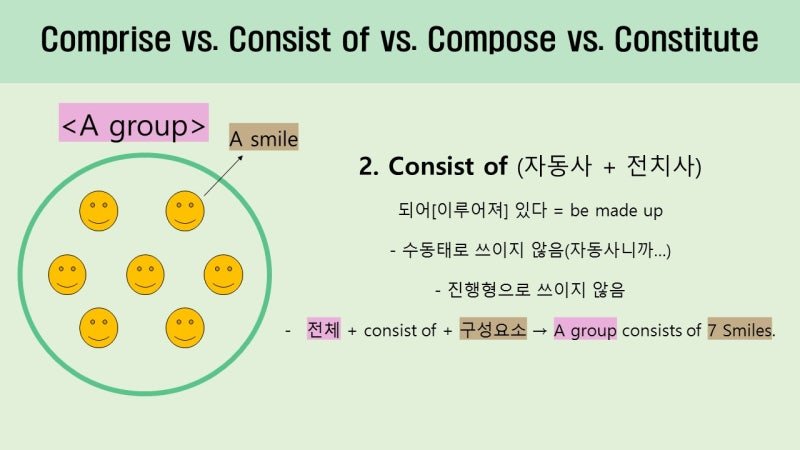
| consists of | made up of | The team consists of ten players. |
In other words:
The team is composed of ten players.
and
The team comprises ten players.
communicate essentially the same idea, but their grammatical structures are different.
“Composed of” requires of, while traditional usage of “comprise” does not.
Is “Comprised Of” Correct?
This is where the discussion becomes more complicated.
The expression “comprised of” is extremely common in modern English. Many writers and speakers use it to mean “composed of” or “consists of.”
For example:
The project is comprised of three stages.
This sentence is widely encountered, but traditional grammar guidance generally recommends:
The project is composed of three stages.
or:
The project comprises three stages.
The reason is that comprise has traditionally been treated as a transitive verb meaning that the whole includes its parts. Therefore, adding “of” after “comprised” was historically viewed as unnecessary or incorrect by many editors and style guides.
However, language changes over time. Modern usage has made “comprised of” increasingly common, and major dictionaries document the construction.
That means the issue is not simply that everyone who uses “comprised of” is misunderstanding English. Rather, it is a case where traditional usage rules and contemporary usage do not always align.
For highly formal writing, using “composed of” or restructuring the sentence with “comprises” is often the clearest way to avoid the controversy.
Composed of vs Comprised Of
Consider these three sentences:
The panel is composed of seven experts.
The panel comprises seven experts.
The panel is comprised of seven experts.
The first two follow the traditional distinction cleanly.
The third is common in contemporary English but may be rejected or edited by publications that follow traditional usage.
If your goal is maximum grammatical clarity in formal writing, the first or second option is usually preferable.
A Simple Rule to Remember
If you want to use composed, use:
is/are composed of
If you want to use comprise, use:
comprises
For example:
The report is composed of four sections.
or:
The report comprises four sections.
Both clearly express the relationship between the whole and its parts.
Comprise vs Compose
Another source of confusion is the difference between the verbs comprise and compose themselves.
Traditionally, they work in opposite directions.
Comprise: Whole to Parts
With “comprise,” the whole generally comes first.
The book comprises ten chapters.
The book is the whole, and the chapters are its parts.
Compose: Parts to Whole
With “compose,” the parts come first when used actively.
Ten chapters compose the book.
Here, the chapters are the elements that make up the whole book.
This creates a useful conceptual distinction:
The whole comprises the parts.
The parts compose the whole.
In passive construction, that becomes:
The whole is composed of the parts.
This relationship is one of the most useful ways to remember the difference.
Examples of Composed and Comprised in Sentences
Seeing the terms in context makes the distinction easier to understand.
Example 1: A Team
The research team is composed of five scientists.
The research team comprises five scientists.
Both sentences describe the same basic structure.
Example 2: A Report
The annual report is composed of eight sections.
The annual report comprises eight sections.
Again, both are conventional constructions.
Example 3: A Business
The company is composed of several independent divisions.
The company comprises several independent divisions.
Both sentences explain the relationship between the organization and its divisions.
Example 4: A Course
The training program is composed of four modules.
The training program comprises four modules.
These are both clear ways to describe the structure of the program.
Common Mistakes With Comprise
Understanding what not to do can be just as useful as learning the preferred forms.
Mistake 1: Using “Comprise Of” in Formal Writing
A common construction is:
The committee comprises of six members.
Traditional standard usage considers this incorrect because comprise already expresses the relationship between the whole and its components.
Use:
The committee comprises six members.
Or:
The committee is composed of six members.
Mistake 2: Reversing the Traditional Structure
Another common issue is putting the parts before the whole with “comprise.”
For example:
Six members comprise the committee.
This construction can be confusing because traditional usage expects the whole to comprise its parts.
A clearer alternative is:
The committee comprises six members.
Or, using “compose”:
Six members compose the committee.
Mistake 3: Mixing Structures
Writers sometimes combine “composed” and “comprise” incorrectly:
The organization is comprise of several departments.
This should be either:
The organization is composed of several departments.
or:
The organization comprises several departments.
When Should You Use “Composed Of”?
“Composed of” is often the easiest choice when you want a natural, straightforward sentence.
It works especially well when the emphasis is on the materials, people, elements, or components that make up something.
For example:
The sculpture is composed of recycled metal.
The committee is composed of representatives from several departments.
The atmosphere is composed primarily of nitrogen and oxygen.
The construction is familiar to readers and generally creates little ambiguity.
When Should You Use “Comprises”?
“Comprises” can be particularly useful in concise formal writing.
For example:
The agreement comprises five sections.
is more compact than:
The agreement is composed of five sections.
In technical, academic, corporate, and legal writing, concise constructions can be useful when the relationship between a whole and its components needs to be stated clearly.
However, writers should be consistent with the grammatical structure they choose.
Is “Composed Of” More Common Than “Comprised Of”?
In ordinary writing, “Composed vs Comprised” is a long-established construction and is generally straightforward.
“Comprised of” is also very common in contemporary English, particularly in business, professional, and general writing. Its widespread use is one reason the traditional rule can feel confusing to modern readers.
The important distinction is that frequency of use and traditional grammatical preference are not always the same thing.
If you are writing for a publication, academic institution, employer, or client with a specific style guide, follow that guide. Some editors will accept “comprised of,” while others will change it to “composed of” or “comprises.”
A Quick Test for Choosing the Right Word
When you’re unsure whether to use “composed” or “comprised,” try replacing the phrase with “made up of.”
If the sentence works naturally, “composed of” is usually a good choice.
For example:
The committee is made up of ten members.
You can write:
The committee is composed of ten members.
You can also write:
The committee comprises ten members.
This simple substitution can help identify the intended relationship.
How to Avoid the Debate Entirely
Sometimes the easiest solution is to use “consists of.”
For example:
The committee consists of ten members.
This construction is clear, conventional, and difficult to misinterpret.
Other alternatives include:
- The team contains ten members.
- The report includes five sections.
- The system has three major components.
- Ten members make up the committee.
- Five sections make up the report.
Choosing an alternative is not a sign that you do not understand the distinction. Good writing often involves selecting the clearest construction rather than forcing a particular word into every sentence.
Why This Distinction Matters in Professional Writing
Grammar choices can affect how polished and precise a document appears.
In casual conversation, readers may not notice the difference between “composed of” and “comprised of.” In professional or edited writing, however, consistency matters.
A technical report, academic paper, business document, or published article may be reviewed according to a specific editorial style. Using a construction that aligns with the publication’s preferences can reduce unnecessary edits.
The broader lesson is that grammar is not only about memorizing isolated rules. It is also about understanding how words function within a sentence and choosing structures that communicate meaning efficiently.
Frequently Asked Questions
Is “composed of” grammatically correct?
Yes. “Composed of” is a standard construction meaning that something is made up of particular parts or elements.
Is “comprised of” grammatically correct?
“Comprised of” is widely used in modern English, and dictionaries document the construction. However, traditional grammar guidance has often discouraged it. In formal writing where traditional usage is expected, “composed of” or “comprises” can avoid the issue.
What is the difference between “composed of” and “comprises”?
“Composed of” means “made up of,” while “comprises” traditionally means “consists of” or “includes.” For example, “The team is composed of five players” and “The team comprises five players” express essentially the same idea.
Should I say “comprises of”?
In traditional standard usage, no. Use “comprises” without “of,” as in “The organization comprises five departments.” Alternatively, use “is composed of.”
Can “compose” and “comprise” be used interchangeably?
Not always. Traditionally, “comprise” describes a whole in relation to its parts, while “compose” describes parts forming a whole. For example, “The book comprises ten chapters” and “Ten chapters compose the book.”
Which is better: “composed of” or “comprised of”?
For formal writing where you want to follow traditional usage, “composed of” is a straightforward choice. “Comprised of” is common in contemporary English, but some editors and style guides still prefer alternatives.
Is “consists of” a good alternative?
Yes. “Consists of” is a clear alternative when you want to explain what makes up a whole without getting into the traditional debate surrounding “comprise.”
Can “comprised” be used as an adjective?
In some contexts, “comprised” can function as a past participle or part of a passive construction, but writers should pay attention to the intended grammatical structure. If the sentence can be expressed more clearly with “composed of” or “comprises,” that may be preferable.
What is the easiest way to remember comprise vs compose?
Remember the traditional direction: the whole comprises the parts, while the parts compose the whole. For the passive construction, use the whole is composed of the parts.
Does using “comprised of” make writing wrong?
Not necessarily in contemporary usage. The expression is widespread and documented, but it remains controversial in some formal contexts because it conflicts with the traditional meaning and grammatical pattern of “comprise.” When in doubt, “composed of” or “comprises” is a safer editorial choice.
Conclusion
The difference between composed vs comprised becomes much easier once you focus on sentence structure.
Use “composed of” when you want to say that a whole is made up of particular parts:
The committee is composed of ten members.
Use “comprises” when the whole comes before its components:
The committee comprises ten members.
The phrase “comprised of” is common in modern English, but it remains less universally accepted in formal writing because traditional grammar guidance has discouraged it.
When clarity matters, you can avoid the controversy altogether with “consists of,” “includes,” or “made up of.” The best choice ultimately depends on the context, audience, and style guide you are following.
For most professional writing, the key is not simply knowing which word sounds familiar. It is understanding the relationship between the whole and its parts—and choosing the construction that expresses that relationship clearly.








1 thought on “Composed vs Comprised What’s the Difference and Which Should You Use?”
Comments are closed.