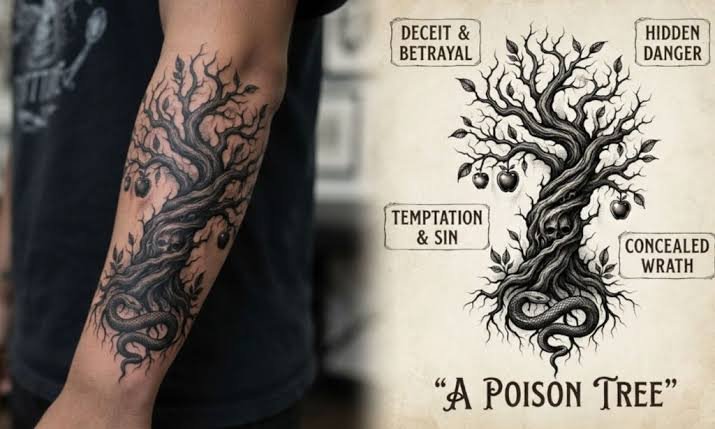
A tree tattoo can represent life, growth, family, strength, or connection to nature. But when the tree is portrayed as poisonous, twisted, dead, or surrounded by dark imagery, its symbolism can become much more complex. For people searching for the poison tree tattoo meaning, the design often raises questions about hidden emotions, consequences, betrayal, temptation, resilience, and the darker side of human experience.
There is no single universal interpretation of a poison tree tattoo. Tattoo symbolism is personal, and the meaning can change depending on the artwork, cultural references, accompanying imagery, and the reason someone chooses the design.
Still, several themes commonly make the poison tree an especially powerful tattoo concept.
What Does a Poison Tree Tattoo Mean?
A poison tree tattoo can symbolize hidden resentment, emotional pain, temptation, toxic relationships, consequences, or personal transformation. It may also represent the idea that something beautiful on the surface can contain something dangerous underneath.
The image becomes especially meaningful when the tree has contrasting elements. For example, a beautiful tree with poisonous fruit can represent an attractive situation with harmful consequences. A dead or twisted tree might instead suggest emotional damage, loss, survival, or a difficult chapter in someone’s life.
Because tattoos are permanent, many people use symbolic designs like this to represent experiences that are difficult to express with words.
The Connection Between Trees and Symbolism
Trees have been used as symbols throughout human history. Their roots, trunks, branches, leaves, flowers, and fruit can each suggest different ideas.
Roots can represent:
- Family and ancestry
- Personal history
- Stability
- Identity
- Connection to one’s past
The trunk can symbolize strength, endurance, or the journey through life. Branches may represent growth, relationships, possibilities, or different paths. Fruit can symbolize results, choices, rewards, or consequences.
Adding the concept of poison changes the traditional symbolism.
Instead of representing growth alone, a poison tree can suggest that growth is not always healthy or that experiences can produce consequences that are difficult to escape.
Poison Tree Tattoo Symbolism
Hidden Resentment
One of the strongest symbolic interpretations comes from the idea of emotions that remain hidden rather than being addressed.
A poison tree can represent anger, resentment, or hurt that grows over time. The tree’s roots can symbolize where those emotions began, while its branches and fruit represent what eventually developed from them.
This interpretation can make the design meaningful for someone who has experienced unresolved conflict.
Toxic Relationships
A poison tree can also symbolize a relationship that appeared attractive but eventually became harmful.
In this context, the tree might represent a person, friendship, family relationship, or romantic connection. Poisonous fruit can emphasize the difference between outward beauty and internal harm.
For someone marking the end of a difficult relationship, the tattoo could serve as a reminder of what they learned rather than simply representing the relationship itself.
Temptation and Consequences
Poison often creates an association with temptation.
Something poisonous may look attractive, particularly when depicted as colorful fruit or beautiful flowers. This contrast can represent choices that seem appealing initially but have consequences later.
A poison tree tattoo can therefore communicate a broader message: not everything that looks beautiful is beneficial.
Pain and Transformation
Dark imagery does not necessarily have a negative meaning.
A person may choose a twisted or poisonous tree to represent a difficult period they survived. In that interpretation, the poison is part of the past, while the tree itself represents continued existence and growth.
The tattoo can become a visual reminder that painful experiences can become part of someone’s identity without completely defining them.
Duality
Another common interpretation is duality.
A tree can simultaneously represent life and danger, beauty and decay, growth and destruction. A tattoo that combines these opposites can reflect the complexity of human experiences.
For example, healthy green leaves combined with poisonous fruit could represent the coexistence of positive and negative experiences.
The Literary Connection: William Blake’s “A Poison Tree”
When discussing poison tree tattoo meaning, it is important to mention the literary association with William Blake’s poem “A Poison Tree.”
Published in Songs of Experience in 1794, Blake’s poem explores anger, suppressed resentment, and the consequences of allowing hostility to grow. The speaker contrasts openly expressing anger toward a friend with hiding anger toward an enemy.
The poem uses the metaphor of a tree growing from concealed anger. As the anger develops, so does the symbolic tree.
Because of this literary connection, a poison tree tattoo may sometimes be inspired by Blake’s work rather than by poisonous plants themselves.
However, not every poison tree tattoo refers to the poem. A tattoo owner may simply use the imagery to express personal experiences, toxic relationships, emotional recovery, or darker aesthetics.
Poison Tree Tattoo Ideas and Their Meanings
The specific design can dramatically change the interpretation.
Poison Tree With Fruit
Poisonous fruit can represent temptation, deception, forbidden choices, or consequences.
A realistic red apple, for example, may create associations with temptation and danger, although the exact meaning depends on the tattoo’s overall composition.
Twisted Poison Tree
A tree with twisted branches can suggest emotional turmoil, hardship, internal conflict, or a difficult life journey.
This style often works well for black-and-gray tattoos because shadows and irregular branches naturally create a darker atmosphere.
Dead Poison Tree
A dead tree may represent loss, endings, grief, isolation, or the conclusion of a difficult chapter.
It can also have a more hopeful interpretation: the end of one stage can make room for something new.
Poison Tree With Flowers
Flowers create an interesting contrast with the poisonous theme.
A beautiful flowering tree may represent how something harmful can appear attractive. Alternatively, flowers may symbolize healing, renewal, or beauty emerging from painful experiences.
Poison Tree With Roots
Visible roots emphasize history and origins.
This design can suggest that current circumstances have deep causes, or that a person’s experiences are permanently connected to their past.
Poison Tree With a Skull
A skull makes the danger symbolism much more direct. It can represent mortality, death, transformation, or awareness of life’s temporary nature.
Because skull imagery has many established tattoo traditions, the surrounding elements are important when determining the intended meaning.
Poison Tree With Snakes
A snake can introduce additional themes such as temptation, transformation, danger, secrecy, or rebirth.
Combined with a poison tree, the imagery can create a particularly dramatic representation of danger and hidden threats.
Does a Poison Tree Tattoo Always Have a Negative Meaning?
No.
The imagery may look dark, but tattoos are not dictionaries with fixed definitions. A person might choose a poison tree because it represents survival, personal boundaries, learning from mistakes, or leaving a toxic situation.
Someone else might choose exactly the same design because they appreciate gothic or dark fantasy artwork.
The meaning ultimately depends on the person wearing it.
This is especially important when interpreting someone else’s tattoo. Assuming that a dark tattoo represents a negative personality or experience can easily lead to an inaccurate conclusion.
Cultural and Personal Context Matters
Tree symbolism varies across cultures and traditions. Trees have been associated with concepts such as life, knowledge, family, spirituality, nature, and connection between different realms.
Adding poisonous imagery can shift those associations, but the result is not necessarily universal.
Personal context matters just as much. A tattoo inspired by a book, poem, movie, family story, personal experience, or artistic preference may have a meaning that cannot be understood from the image alone.
If you’re considering a poison tree tattoo for yourself, think about what you want the design to communicate before choosing specific details.
How to Make the Meaning More Personal
A symbolic tattoo becomes more distinctive when its details connect to your own story.
Consider questions such as:
What does the tree represent in your life?
What do the roots symbolize?
Why is the tree poisonous?
Does the fruit represent temptation, consequences, or something else?
Is the tree dying, surviving, or growing?
Do you want the tattoo to represent the past, present, or future?
Your answers can guide the artist toward a design that communicates Poison Tree Tattoo Meaning something personal rather than simply reproducing a popular tattoo concept.
Choosing the Right Tattoo Style
The visual style can influence how people perceive the symbolism.
A black-and-gray poison tree tattoo can create a somber, traditional, or dramatic appearance. Fine-line work can make the same concept feel delicate and understated.
A color tattoo can emphasize poisonous fruit, flowers, leaves, or other details. Deep reds, purples, greens, and darker shades can create strong visual contrast, although color selection should ultimately reflect the desired aesthetic rather than an assumed universal meaning.
A minimalist tree tattoo can communicate the concept without excessive detail, while a large illustrative piece can incorporate roots, animals, landscapes, text, or other symbolic elements.
Where Should You Get a Poison Tree Tattoo?
Placement depends on the size and complexity of the design.
A small minimalist tree may work well on areas such as the forearm, upper arm, ankle, or calf. Larger designs can provide enough space for detailed roots, branches, fruit, and surrounding imagery.
Before deciding, consider visibility, available space, the tattoo’s eventual size, and how the design will follow the natural shape of the body.
A professional tattoo artist can also explain how much detail is practical for the chosen placement.
Is a Poison Tree Tattoo a Good Choice for You?
The most useful question is not whether the design has a universally recognized meaning. Instead, ask whether the symbolism reflects something you genuinely want to carry with you.
If you associate the image with overcoming toxicity, learning from past experiences, recognizing consequences, or accepting life’s complexity, the concept can have considerable personal significance.
If you mainly like the visual style, that is also a valid reason to choose it. Not every tattoo needs a deeply symbolic explanation.
Frequently Asked Questions
What is the poison tree tattoo meaning?
A poison tree tattoo can symbolize hidden resentment, toxic relationships, temptation, consequences, emotional pain, transformation, or survival. Its exact meaning depends on the individual and the design.
Does a poison tree tattoo represent anger?
It can. The association is particularly strong when the design is inspired by William Blake’s poem A Poison Tree, which uses a growing tree as a metaphor for concealed anger and resentment.
What does a poison tree with fruit symbolize?
Poisonous fruit can represent temptation, deception, dangerous choices, or consequences. The meaning can change depending on the type of fruit and other tattoo elements.
Is a poison tree tattoo negative?
Not necessarily. The tattoo can represent difficult experiences, but it can also symbolize survival, personal growth, learning, transformation, or leaving a harmful situation.
What does a dead poison tree tattoo mean?
A dead poison tree may represent loss, endings, emotional damage, or the conclusion of a difficult period. Some people may also interpret it as a symbol of moving beyond something harmful.
What does a poison tree with roots symbolize?
Visible roots can emphasize a connection to the past, family history, personal experiences, or the origins of emotional struggles.
Is the poison tree associated with William Blake?
Yes. William Blake’s poem A Poison Tree, published in 1794, uses the image of a tree growing from concealed anger. This literary connection is one possible inspiration for the tattoo concept.
Can a poison tree tattoo represent healing?
Yes. A person may use the imagery to represent surviving a toxic experience and growing beyond it. The poisonous elements can symbolize what happened in the past rather than the person’s current identity.
What colors work for a poison tree tattoo?
Black and gray can create a darker, understated Poison Tree Tattoo Meaning appearance, while color can highlight poisonous fruit, flowers, or foliage. The best palette depends on the intended style and the tattoo artist’s approach.
Should a poison tree tattoo have a specific meaning?
No. Tattoo symbolism is personal. You can choose a poison tree because it represents a particular experience, because of its literary connection, or simply because you like the artwork.
Final Thoughts
The poison tree tattoo meaning is ultimately shaped by contrast: beauty alongside danger, growth alongside pain, and attraction alongside consequences. Its symbolism can connect to resentment, toxic relationships, temptation, personal history, transformation, or survival.
The connection to William Blake’s A Poison Tree gives the concept Poison Tree Tattoo Meaning an important literary interpretation, but it is only one possibility. The same image can carry a completely different meaning for another person.
If you’re considering this tattoo, focus less on finding one official definition and more on designing an image that reflects your own story. Roots, branches, fruit, flowers, decay, color, and surrounding symbols can all turn a familiar concept into something uniquely personal.





1 thought on “Poison Tree Tattoo Meaning What Does This Dark Symbol Represent?”
Comments are closed.