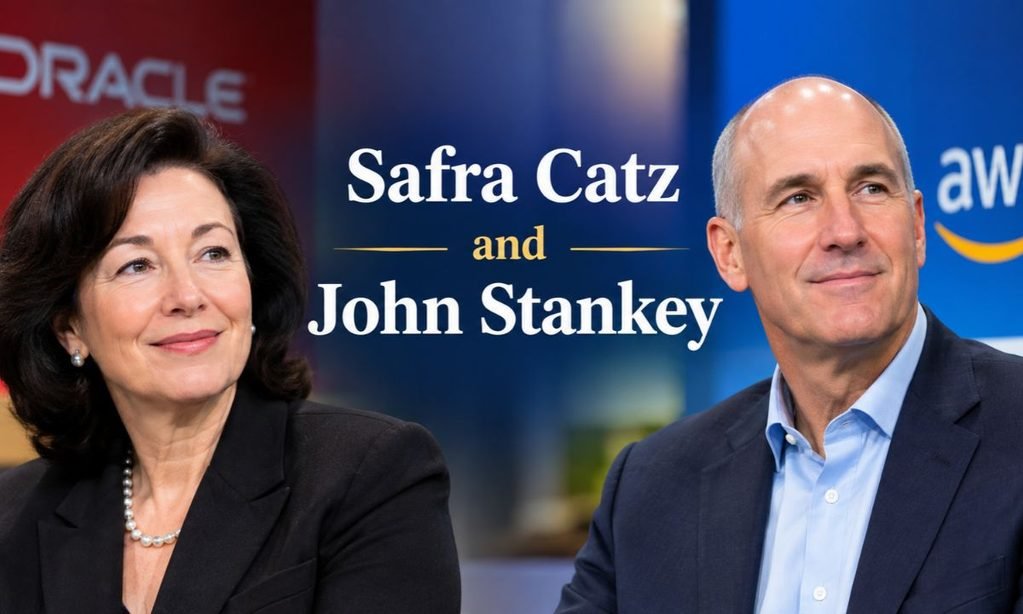
The American business landscape is shaped by executives who make important decisions about technology, corporate strategy, financial performance, and long-term growth. Among the prominent names in this environment are Safra Catz and John Stankey. Both have built extensive careers in major corporations, developed reputations for managing complex organizations, and influenced industries that affect millions of customers and businesses.
Although their professional paths are different, Safra Catz and John Stankey offer an interesting comparison of modern corporate leadership. Catz is closely associated with Oracle, one of the world’s major enterprise technology companies, while Stankey has spent much of his career at AT&T, a major telecommunications and media business.
Understanding their backgrounds, career achievements, management approaches, and professional responsibilities provides a useful perspective on how leadership operates in two important sectors of the American economy.
Who Are Safra Catz and John Stankey?
Safra Catz and John Stankey are American corporate executives known for their leadership roles at major publicly traded companies. Their careers reflect different approaches to business management, organizational development, and strategic decision-making.
Safra Catz built her reputation through financial management, corporate operations, and executive leadership at Oracle. John Stankey developed his career through telecommunications, corporate strategy, and senior management positions at AT&T.
Their professional journeys demonstrate how executives can rise through large organizations by combining industry knowledge, operational experience, and the ability to manage significant business responsibilities.
Safra Catz: A Leading Figure at Oracle
Safra Catz is an Israeli-American business executive who became one of the most recognizable leaders in the technology industry through her work at Oracle.
She joined Oracle in 1999 and gradually assumed increasingly important responsibilities within the company. Her experience in finance, acquisitions, and corporate management helped establish her position among Oracle’s senior leadership.
Catz became Oracle’s chief executive officer in 2014, initially sharing the position with Mark Hurd. Following Hurd’s death in 2019, she continued as the company’s sole CEO.
Her leadership has been associated with Oracle’s strategic development in enterprise software, cloud infrastructure, database technology, and business applications.
John Stankey: A Telecommunications Industry Executive
John Stankey is an American business executive recognized for his long career at AT&T.
He joined the company in 1985 and worked in several leadership positions across its telecommunications, entertainment, and business operations. Over time, he became involved in major corporate decisions involving broadband services, wireless networks, media assets, and organizational strategy.
Stankey became AT&T’s chief operating officer before succeeding Randall Stephenson as chief executive officer in July 2020.
His career illustrates the complexity of managing a telecommunications company operating in a highly competitive environment where technology, infrastructure, customer expectations, and regulation continuously evolve.
Educational Background and Early Career Development
The professional achievements of both executives are rooted in their education and early exposure to business.
Safra Catz’s Education and Professional Beginnings
Safra Catz studied at the University of Pennsylvania, earning a bachelor’s degree from its Wharton School. She subsequently received a law degree from the University of Pennsylvania Law School.
Before joining Oracle, she worked in investment banking at Donaldson, Lufkin & Jenrette. Her experience in financial markets, corporate transactions, and business analysis provided a foundation for her later responsibilities.
Her background was particularly relevant as Oracle expanded through acquisitions and developed its position in the global enterprise software market.
Catz joined Oracle in 1999 and became increasingly involved in its corporate strategy and financial management. She served as president beginning in 2004 and held senior financial leadership positions before becoming CEO.
John Stankey’s Education and Career Development
John Stankey earned a bachelor’s degree in finance from Loyola Marymount University and an MBA from the University of California, Los Angeles.
He joined AT&T in 1985 and developed his career through a wide range of operational and executive positions.
His responsibilities included information technology, telecommunications operations, business services, corporate strategy, and entertainment.
This broad experience gave him an understanding of how different parts of a large telecommunications organization operate together.
Unlike executives who enter a company directly into a senior leadership position, Stankey spent decades working within the same corporate organization before reaching its highest executive office.
Safra Catz’s Leadership Journey at Oracle
Oracle is a major enterprise technology company known for database software, cloud computing, enterprise applications, and infrastructure services.
Catz played an important role in the company’s development during a period when technology businesses were experiencing significant changes.
Corporate Acquisitions and Business Expansion
One of the defining aspects of Catz’s executive career was her involvement in Oracle’s acquisition strategy.
Large technology acquisitions can help companies expand their product portfolios, enter new markets, and strengthen relationships with existing customers. However, successful acquisitions require careful financial planning and integration.
Oracle pursued several major acquisitions during Catz’s years in senior leadership. These transactions contributed to the company’s expansion across enterprise software and business technology.
Her financial and operational experience was particularly relevant to evaluating corporate transactions and managing the organizational challenges that follow them.
The Transition Toward Cloud Computing
The growth of cloud computing changed how businesses purchase, maintain, and use technology.
Traditional software models often required organizations to operate their own servers and maintain extensive internal infrastructure. Cloud services offered another approach, allowing companies to access computing resources through online platforms.
Oracle responded to this industry shift by expanding its cloud applications and infrastructure offerings.
Catz’s leadership coincided with this strategic transition. The company worked to strengthen its position in enterprise cloud services while continuing to support customers using established Oracle technologies.
Her Role After Leaving the CEO Position
An important development in Catz’s career occurred in September 2025.
After serving as Oracle’s CEO for approximately 11 years, she transitioned to the position of Executive Vice Chair of the Oracle Board of Directors.
This change was part of the company’s leadership succession process. Oracle appointed new chief executives while Catz moved into a different executive and board-level role.
Her experience remains relevant to Oracle’s governance, institutional knowledge, and long-term strategic direction. She also serves as a lecturer at Stanford Graduate School of Business and has held other corporate board responsibilities.SEC+1
John Stankey’s Leadership Journey at AT&T
John Stankey’s career reflects the development of the American telecommunications industry, from traditional telephone services to modern wireless networks, broadband connectivity, and digital infrastructure.
AT&T operates in a competitive market where companies must continuously invest in technology while managing customer expectations and substantial infrastructure costs.
Experience Across Multiple Business Divisions
Before becoming CEO, Stankey held several important leadership positions at AT&T.
His professional responsibilities included:
- Chief Information Officer.
- Chief Technology Officer.
- President and CEO of AT&T Operations.
- President and CEO of AT&T Business Solutions.
- Chief Strategy Officer.
- CEO of AT&T Entertainment Group.
- CEO of WarnerMedia.
- President and Chief Operating Officer of AT&T.
These roles provided exposure to different aspects of the company’s operations.
His experience in technology and business strategy was particularly relevant to managing an organization that serves consumers, government agencies, and businesses.
Becoming AT&T’s CEO
Stankey became AT&T’s president and CEO in July 2020, succeeding Randall Stephenson.
His appointment came during a period of considerable change for the telecommunications industry.
The company was balancing its traditional wireless and broadband operations with the consequences of its expansion into entertainment and media.
As CEO, Stankey became responsible for overseeing corporate strategy, financial performance, operational priorities, and major investment decisions.
In February 2025, he was also elected chairman of AT&T’s board of directors.
He therefore holds both the chairman and chief executive positions, giving him responsibilities across the company’s executive management and board leadership.investors.att.com+1
Refocusing AT&T on Connectivity
One of the significant themes of Stankey’s leadership has been AT&T’s strategic focus on connectivity.
The company previously expanded into entertainment and media through major transactions involving WarnerMedia. However, its subsequent restructuring reflected a stronger emphasis on telecommunications and network infrastructure.
AT&T’s strategy increasingly centers on:
- Expanding fiber-optic broadband availability.
- Improving 5G wireless network capabilities.
- Strengthening network reliability.
- Serving residential and business connectivity customers.
- Investing in infrastructure for growing data demand.
These priorities reflect broader changes in how Americans work, communicate, stream entertainment, and access digital services.
High-speed internet and dependable wireless connectivity have become essential to households and businesses. As a result, decisions about network investment can influence both customer experience and long-term corporate competitiveness.
Safra Catz and John Stankey: Comparing Their Leadership Styles
Although both executives have managed large corporations, their professional backgrounds and industries create important differences.
Catz developed considerable expertise in financial management, corporate transactions, and enterprise technology. Stankey built his career around telecommunications operations, technology infrastructure, and organizational strategy.
Their leadership experiences can be compared across several areas.
| Leadership area | Safra Catz | John Stankey |
|---|---|---|
| Main company | Oracle | AT&T |
| Primary industry | Enterprise technology | Telecommunications |
| Major expertise | Finance and corporate strategy | Operations and network technology |
| Career background | Investment banking and technology | Long-term telecommunications management |
| Former CEO tenure | 2014–2025 | Since July 2020 |
| Current leadership role | Executive Vice Chair, Oracle Board | Chairman and CEO, AT&T |
Financial Strategy Versus Infrastructure Management
Catz’s background in investment banking and corporate finance helped shape her approach to major business decisions.
Oracle’s competitive position depends on technology development, enterprise customer relationships, cloud infrastructure, and the effective management of its product portfolio.
Stankey operates in a different environment.
AT&T must maintain and expand physical infrastructure while competing with other wireless and broadband providers. Its decisions involve substantial capital investment, network planning, customer acquisition, and service reliability.
Neither leadership approach is inherently better. Each reflects the specific challenges of the industry and organization involved.
Managing Organizational Change
Both executives have worked through significant corporate transformations.
At Oracle, the shift toward cloud computing required changes in product development, sales strategies, customer relationships, and infrastructure.
At AT&T, changing its business focus and investing in advanced connectivity required decisions about corporate structure, technology priorities, and long-term capital allocation.
These experiences demonstrate that successful corporate leadership involves more than maintaining existing operations. Executives must also identify changes in customer needs and adapt their organizations accordingly.
What Is the Connection Between Safra Catz and John Stankey?
People searching for Safra Catz and John Stankey may be wondering whether the two executives are related, have worked together, or share a professional connection.
Their publicly documented careers are associated with different companies and industries.
Catz is primarily associated with Oracle’s enterprise technology business, while Stankey’s career has centered on AT&T and telecommunications.
There is no established public evidence that they are relatives, business partners, or former colleagues at the same company.
Their names are relevant together because both have occupied influential positions in major American corporations. Their careers also provide an interesting comparison of leadership in the technology and telecommunications sectors.
It is important to distinguish between a shared appearance in business-related searches and an actual personal or professional relationship. Without reliable documentation, assumptions about a connection should be avoided.
The Industries They Represent and Their Economic Influence
The careers of Catz and Stankey also highlight the importance of two interconnected industries in the American economy.
Oracle and the Enterprise Technology Market
Oracle provides technology solutions used by companies, public institutions, and organizations around the world.
Its business includes database management systems, cloud infrastructure, enterprise resource planning, and other business applications.
These technologies support essential organizational activities, including financial reporting, data management, supply chain operations, and customer relationship management.
Catz’s long association with Oracle placed her at the center of important developments in enterprise technology.
The company’s continued evolution illustrates how established technology businesses must adapt to changing customer expectations and competition from cloud-focused providers.
AT&T and the Telecommunications Industry
AT&T plays a significant role in America’s communications infrastructure.
Its wireless and broadband services support everyday activities such as remote work, online education, digital payments, entertainment, and business communication.
The telecommunications industry requires continuous infrastructure investment because customer demand for faster and more reliable connections continues to evolve.
Stankey’s leadership involves balancing these investment requirements with financial discipline, competitive pressures, and customer satisfaction.
The company’s emphasis on fiber and 5G demonstrates how telecommunications providers are adapting to the growing importance of high-speed connectivity.
Leadership Lessons From Their Professional Careers
The careers of Safra Catz and John Stankey offer several useful observations for aspiring executives, business owners, and management professionals.
Industry Knowledge Matters
Both executives developed substantial experience in their respective industries.
Catz combined financial expertise with knowledge of enterprise technology. Stankey developed an understanding of telecommunications through decades of work across different business divisions.
Their careers demonstrate the value of understanding how an industry operates before making major strategic decisions.
Long-Term Planning Requires Flexibility
Technology and telecommunications companies operate in rapidly changing environments.
Business models that are successful today may become less competitive as customer behavior and technology evolve.
Oracle’s cloud transition and AT&T’s connectivity-focused strategy illustrate why companies need to reassess their priorities regularly.
Financial Discipline Supports Sustainable Growth
Corporate expansion requires more than ambitious plans.
Executives must evaluate costs, risks, investment requirements, and potential long-term returns.
Catz’s financial background and Stankey’s experience managing large operational organizations highlight different but complementary aspects of corporate financial discipline.
Leadership Is an Ongoing Process
Reaching a CEO position does not eliminate the need for professional development.
Both careers demonstrate the importance of learning, adapting, managing relationships, and responding to organizational challenges.
Their professional experiences also show that leadership responsibilities can change over time, as illustrated by Catz’s transition from CEO to Executive Vice Chair.
Frequently Asked Questions About Safra Catz and John Stankey
1. Who are Safra Catz and John Stankey?
Safra Catz is a prominent business executive associated with Oracle, where she served as CEO from 2014 to 2025. John Stankey is the chairman and CEO of AT&T, with a career spanning multiple decades in telecommunications and corporate management.
2. Are Safra Catz and John Stankey married or related?
There is no reliable public information establishing that Safra Catz and John Stankey are married or related. Their professional backgrounds are associated with separate corporations.
3. What is Safra Catz’s current position at Oracle?
As of November 2026, Safra Catz serves as Executive Vice Chair of Oracle’s Board of Directors. She transitioned from her CEO and principal financial officer positions in September 2025.
4. Is John Stankey still the CEO of AT&T?
Yes. John Stankey remains AT&T’s chairman and CEO as of November 2026. He has served as CEO since July 2020 and became chairman in February 2025.
5. How long did Safra Catz serve as Oracle CEO?
Safra Catz served as Oracle’s CEO from September 2014 until September 2025, approximately 11 years.
6. How long has John Stankey worked at AT&T?
John Stankey joined AT&T in 1985. His career at the company spans more than four decades, including senior positions in technology, operations, strategy, and executive management.
7. What companies are associated with Safra Catz and John Stankey?
Safra Catz is primarily associated with Oracle, while John Stankey is associated with AT&T. Both companies are major participants in the American technology and communications economy.
8. What did Safra Catz do before joining Oracle?
Before joining Oracle in 1999, Catz worked in investment banking at Donaldson, Lufkin & Jenrette. This experience helped develop her expertise in financial management and corporate transactions.
9. What did John Stankey do before becoming AT&T CEO?
Before becoming CEO, Stankey held numerous leadership positions at AT&T, including chief technology officer, chief strategy officer, chief operating officer, and CEO of WarnerMedia.
10. Why are Safra Catz and John Stankey discussed together?
They are often considered together because both are influential American corporate executives with extensive experience managing major organizations. Safra Catz and John Stankey Their careers offer an opportunity to compare leadership in enterprise technology and telecommunications.
Conclusion
Safra Catz and John Stankey represent two different but important paths to executive leadership in American business. Catz built her reputation through financial expertise, corporate strategy, and more than two decades of leadership at Oracle. Stankey developed his career through telecommunications, technology operations, and senior management responsibilities at AT&T.
Their professional journeys highlight the importance of industry knowledge, strategic planning, financial discipline, and organizational adaptability.
Although there is no established public evidence of a direct personal relationship between them, their careers provide useful insight into how major American companies are managed and how experienced executives influence industries undergoing continuous technological change.
Understanding their backgrounds also helps readers distinguish between their individual achievements, current responsibilities, and the companies they represent.





1 thought on “Safra Catz and John Stankey Two Influential Leaders Shaping American Business”
Comments are closed.